
Ana V’chkova: Pampered, spoiled, tenderly kept
25.09.–04.10.

Ana V’chkova: Pampered, spoiled, tenderly kept
Wo endet Zärtlichkeit und wo beginnt Kontrolle? Die Ausstellung „Галена, мазена, пазена“ („Verhätschelt, verwöhnt, zärtlich behütet“) beschäftigt sich mit dem komplexen Zusammenspiel von Erinnerung und Fürsorge und legt die Spannung offen, die sich hinter Schutz, Geborgenheit und häuslichen Ritualen verbirgt.
In ihren Arbeiten bewegt sich Ana V’chkova zwischen dem Persönlichen und dem Gesellschaftlichen, zwischen Intimität und Alltag. Mit Fotografie, Malerei, Video und Mixed Media setzt sie sich mit Fragen von Identität, Weiblichkeit, Fürsorge und den Erwartungen auseinander.
Ihre Arbeiten bewegen sich oft zwischen Ordnung und Chaos, Verletzlichkeit und Widerstandskraft und machen emotionale und psychologische Ebenen sichtbar, die unter vertrauten Situationen und alltäglichen Routinen liegen. Für ihre kommende Ausstellung im Prima Center Berlin setzt V’chkova diese Auseinandersetzung mit dem Intimen, dem Privaten und den Räumen, die wir bewohnen, fort – und mit der Frage, was diese über uns erzählen können.
Ana V’chkova: Галена, мазена, пазена | Verhätschelt, verwöhnt, zärtlich behütet
25.09.–04.10.
Vernissage: 25.09., 18:00
Prima Center Berlin
Exhibition announcement (EN)
Where does tenderness end and control begin? „Галена, мазена, пазена“ explores the intricate interplay of memory and care, exposing the tension hidden within protection, comfort, and domestic ritual.
In her work, Ana V’chkova explores the spaces between the personal and the social, between intimacy and everyday life. Working across photography, painting, video and mixed media, she examines questions of identity, femininity, care and the expectations that shape our lives. Her works often move between order and chaos, vulnerability and resilience, revealing the emotional and psychological layers hidden beneath familiar situations and everyday routines.
For her upcoming exhibition at Prima Center Berlin, V‚chkova continues this exploration of the intimate, the domestic and the spaces we inhabit — and what they might reveal about us.
*Image: „Кога женско се раѓа и стреите плачат V“ 2022 Dimensions: 26.5 x 40cm
Ana V‚chkova: Галена, мазена, пазена | Pampered, spoiled, tenderly kept
25.09.–04.10.
Vernissage: 25.09., 18:00
Prima Center Berlin
UNRULY SURFACES (Curatorial text, EN)
On the body, the home, and the impossibility of perfect order: Towards Ana V’chkova’s exhibition „Pampered, Spoiled, Tenderly kept“
by Dr. Ana Frangovska
The home is never just a space. It is a collection of habits, repetitions, touches, smells, remnants, and small daily disciplines through which we attempt to establish order in something that constantly slips away from us. In it, the body rests, feeds, exposes itself, is nurtured, ages, and changes; in it, objects, waste, memories, and traces accumulate. The home is perhaps the most intimate architecture we inhabit, but at the same time one of the most normative.
In Ana V’chkova’s new body of work, this very contradiction becomes the starting point of visual exploration. Her interest in domestic space is not new; it is already present as an investigation of the place where the intimate and the routine intertwine, and where relationships of care, control, and the need for order take on their daily form. But in the new works, the home is no longer just a theme or a set design. It becomes a material, bodily, and psychological condition.
The photographs stem from the vocabulary of everyday life: a sink, a drain, food, overripe fruit, flowers, insects, plates, lace, female skin, hands, feet, body fragments. These are things that, in the conventional regime of viewing, we categorize into different realms—beautiful and ugly, clean and unclean, desirable and undesirable, intimate and public. V’chkova deliberately brings them into close proximity and strips these divisions of their certainty.
Flowers appear next to the grime in the drain; decorative lace surrounds an insect; overripe fruit sits on the boundary between sustenance and decay; the female body overlaps with fabric, and skin with the surface of the image. The beautiful and the uncomfortable can no longer be easily separated.
It is precisely this instability that brings the works close to Julia Kristeva’s concept of the abject. The abject is not simply what is ugly or repulsive, but what disrupts the stability of the boundaries through which we organize our world—between the clean and the unclean, the inside and the outside, the body and what the body expels (Kristeva 1982). It evokes revulsion, yet simultaneously possesses a strange power to captivate the gaze.
In V’chkova’s work, however, the abject does not turn into a spectacle of disgust. On the contrary, it is carefully woven into the allure of the image. The flower remains beautiful beside the dirt; the skin remains sensual even when deformed; the insect becomes an almost decorative element; the sheen of the textile draws the hand and the eye at the exact moment when what is depicted might cause discomfort. Instead of a clear boundary, a state of simultaneous attraction and repulsion is created. It is precisely this ambivalence that holds the viewer’s gaze.
Yet the home in V’chkova’s work is not a neutral place where these scenes happen by chance. It is a structure organized through repetition: cleaning, feeding, tidying, washing, preserving, caring. Hence, the project continues the feminist trajectory already present in her research.
Behind the kitchen, the sink, the food, and its remnants lies the repetition of domestic and reproductive labor—precisely the invisible labor written about by Silvia Federici (2012). What is washed will get dirty again, what is tidied will be disrupted, prepared food will be eaten, and order will turn back into chaos.
However, the home does not have to be read exclusively as a site of discipline and oppression; it can also be a space of care, affirmation, and resistance—a place where the subject can establish relations different from those imposed by the outside world (Hooks 1990).
This duality is crucial for V’chkova. In her work, the home is neither a prison nor an idyllic refuge. It is a contradictory zone of care and exhaustion, intimacy and control, belonging and the urge to escape—a dialectic that the artist also sets within her own conceptual framework. Thus, the objects in these works are not merely domestic props. The drain, the plate, the textile, the food, the lace—they are objects around which the body moves daily and through which it inhabits space.
The relationship between the body, objects, and domestic space draws close to Sara Ahmed’s concept of orientation, according to which bodies move through the world following established lines of familiarity, habit, and use (Ahmed 2006). In V’chkova’s work, these very familiar lines are interrupted.
The sink is no longer just a sink, the plate does not serve only for food, the lace is not merely an ornament. The body, too, does not remain a stable center of the image. Familiar things are present, but their mutual relationships are displaced, creating a kind of disorientation of the domestic. What we know becomes slightly strange.
Yet this displacement does not end with what is photographed. On the contrary, the most radical operation in the cycle occurs on the photograph itself. The photograph ceases to be a flat, stable surface. Printed on textile, it gathers, folds, creases, stretches, and deforms. Needles pierce it. Metal elements fix it and simultaneously wound it. Lace surrounds, conceals, or decoratively disciplines it. Epoxy resin hardens it, while giving it a wet, glossy, almost organic presence. The image becomes skin.
This is where the crucial shift of the project takes place: the central inquiry is no longer found only in what the image represents, but also in what happens to the image as material. The photographic image behaves like a body. It can be touched, stretched, gathered, pierced, folded. And like the body, it can never be fully reduced to a stable, ideal form. This active role of the material aligns with Jane Bennett’s new-materialist understanding, which challenges the assumption that matter is a passive substance and insists on its agency in producing relationships and events (Bennett 2010). In V’chkova’s work, matter is indeed not a silent carrier of the photographic representation.
The textile strikes back. The fold decides what remains visible and what disappears. The tension distorts the anatomy. The needle creates an indentation. The resin alters light and tactility. Gravity reshapes the form with every new installation. Therefore, the „unruliness“ of the surface is not merely a metaphor; it is a material condition of the work.
From this arises their ambiguous medium position. These works can no longer simply be called photographs, nor do they become sculptures. They deliberately remain between image and object, representation and matter, illusion and physical body.
This intermediality was already foreshadowed in the artist’s prior research, where photography, painting, and object structures were conceived as a fluid, sculptural whole. In this new cycle, that logic takes on an even more pronounced material form.
The approximate dimensions of 110 × 80 cm further accentuate the bodily relationship with the viewer. However, they should not be understood as a fixed, final measurement. That is the dimension of the material prior to its spatial transformation. Through creasing, stretching, and bulging, each work produces its own variable dimension and its own relationship to the wall and space.
The fold becomes particularly significant. It is not a decorative effect. The fold disrupts the authority of the photographic representation. One part of the image disappears into it, another elongates, a third meets something that was distant in the original photograph. The body becomes a landscape, the object resembles an organ, the flower can become a wound. Representation is no longer secure.
In this sense, the unruliness of the surface can also be read as unruliness toward the regimes through which the female body and domestic space have traditionally been organized, disciplined, and represented. The use of lace is especially interesting. It carries the heritage of domestic decorativeness and female handiwork—labor invested to keep the home beautiful, respectable, orderly.
In V’chkova’s work, lace is pulled out of this safe role. Placed alongside insects, organic remnants, body fragments, and deformed photographic surfaces, lace no longer beautifies reality; it becomes a trace of a cultural model of femininity.
Needles function similarly. A needle joins, fastens, and repairs—but a needle also pierces. It can be an instrument of care and domestic labor, as well as an instrument of injury. In V’chkova’s work, this duality deliberately remains unresolved: care and violence sometimes utilize the exact same gesture.
Hence, the attraction of these works is never entirely comfortable. At first glance, we are drawn in by the sheen of the fabric, the intense color, the flowers, the skin, the lace, and the sensuality of the surface. But the longer we look, the more the dirt, overripeness, insects, waste, folds, punctures, and bodily discomfort seep into the frame.
The viewer is caught in that very Kristevian ambivalence from which we began: wanting to move closer and step back at the same time. But perhaps even more importantly—wanting to look again. In that second look lies the essence of the project. Ana V’chkova does not create images of idealized intimacy. She reveals intimacy as a material condition—beautiful and unsettling, tender and violent, erotic and banal, clean and unclean.
The home is neither a safe refuge nor an unambiguous place of oppression. It is a space in which our notions of order, the body, and normality are daily produced and disassembled. That is why the form of these works refuses to be „tidy.“ It crumples, gathers, pierces, expands, and contracts. It refuses to stay within the frame—just like the body, the home, and the life we persistently try to bring into order.
References
- Ahmed, Sara. 2006. Queer Phenomenology: Orientations, Objects, Others. Durham, NC: Duke University Press.
- Bennett, Jane. 2010. Vibrant Matter: A Political Ecology of Things. Durham, NC: Duke University Press.
- Federici, Silvia. 2012. Revolution at Point Zero: Housework, Reproduction, and Feminist Struggle. Oakland: PM Press.
- Hooks, Bell. 1990. „Homeplace: A Site of Resistance.“ In Yearning: Race, Gender, and Cultural Politics. Boston: South End Press.
- Kristeva, Julia. 1982. Powers of Horror: An Essay on Abjection. Translated by Leon S. Roudiez. New York: Columbia University Press.
Die Künstlerin (DE)
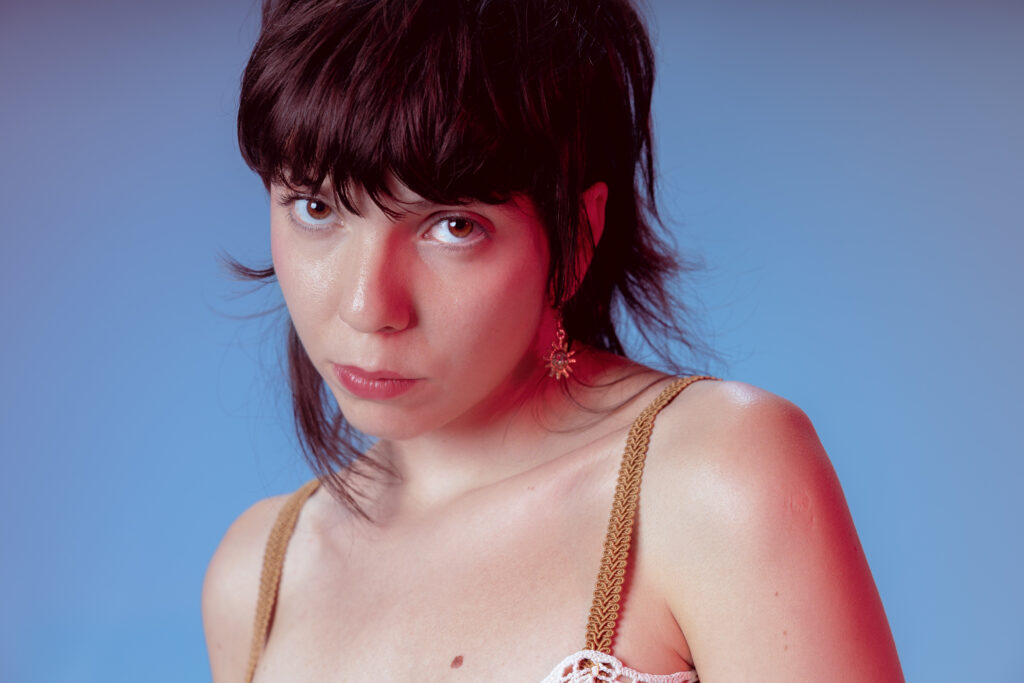
Ana V’chkova (geb. 1998) ist eine bildende Künstlerin. Sie hat einen Bachelorabschluss in Malerei mit Szenografie an der Fakultät für Bildende Künste der Universität „Hl. Kyrill und Method“ (UKIM) in Skopje erworben. Ihre von Grund auf intermediale Praxis löst die Grenzen zwischen Malerei, Fotografie, Grafikdesign und Video auf. Angezogen von der Spannung und Harmonie zwischen unterschiedlichen Texturen und Techniken verfolgt V’chkova einen hybriden Ansatz, der die Grundlage ihrer künstlerischen Auseinandersetzung bildet. Auf diese Weise entwickelt sie nuancierte, haptisch anmutende Erzählungen, die eine unmittelbare, viszerale Resonanz bei den Betrachter*innen hervorrufen. V’chkovas Arbeit untersucht den fließenden Dialog zwischen Medium und Botschaft und zielt darauf ab, eine unmittelbare und nachhaltige Verbindung zum Publikum herzustellen. Durch die Verbindung traditioneller visueller Formen mit zeitgenössischen digitalen Verfahren destabilisiert sie etablierte künstlerische Konventionen und gewohnte Formen des Sehens. Ihrer Praxis liegt die Überzeugung zugrunde, dass Form und Inhalt untrennbar miteinander verbunden sind und sich gegenseitig fortwährend bedingen und verändern.
Ihre forschungsbasierte Praxis setzt sich mit drängenden sozialen und feministischen Fragestellungen auseinander. Dabei versteht sie stille, verinnerlichte Formen von Unterdrückung und strukturelle Stigmatisierungen nicht als isolierte persönliche Erfahrungen, sondern als Symptome umfassender, vielschichtiger gesellschaftlicher Strukturen. Anstatt diese belastenden Realitäten durch eine distanzierende Bildsprache zu vermitteln, übersetzt V’chkova sie in eine verletzliche, intime visuelle Sprache, die eine Verbindung zwischen dem Kunstwerk und dem Publikum schafft.
V’chkova ist Mitglied des Verbands der Bildenden Künstler*innen Mazedoniens (DLUM). Sie hat an zahlreichen internationalen Residenzen und Gruppenausstellungen teilgenommen und ihre Arbeiten präsentiert, darunter die Galichnik Art Colony (2025), das Non-linear Archive in Shkodër (2025), die Tiiiit! Summer School for Feminist Dramaturgical Thinking (2025) und die Infrared Residency in Prishtina (2024). Darüber hinaus wurden ihre Arbeiten bei „Skopje Urban Stories“ (2025), „Femina“ (2024), dem Winter Salon (2024), „Skala“ (2022) und der Manchester Art Fair (2021) präsentiert.
2025 zeigte sie eine Einzelausstellung im Rahmen des „Dzirni“ Film Festivals in Skopje. Dieser ging ihre erste Einzelausstellung „Diversus“ im Jugendkulturzentrum (MKC) in Skopje im Jahr 2023 voraus, die mit Unterstützung des Ministeriums für Kultur und Tourismus der Republik Nordmazedonien realisiert wurde.
The Artist (EN)
Ana V’chkova (b. 1998) is a visual artist who holds a BA in Painting with Scenography from the Faculty of Fine Arts at Ss. Cyril and Methodius University (UKIM) in Skopje. Her inherently intermedial practice dissolves the boundaries between painting, photography, graphic design, and video. Drawn to the friction and harmony between disparate textures and techniques, V’chkova employs a hybrid approach that serves as the bedrock of her creative inquiry. This allows her to construct nuanced, highly tactile narratives that foster an immediate, visceral resonance with the viewer. V’chkova’s work interrogates the fluid dialogue between medium and message, aiming to establish an unmediated and enduring connection with the audience. By synthesizing traditional visual forms with contemporary digital processes, she destabilizes received artistic conventions and habitual modes of seeing. Her practice is anchored in the conviction that form and subject matter are inextricable, each perpetually conditioning and mutating the other.
Her research-driven practice unpacks urgent social and feminist critiques, positioning quiet, internalized oppressions and structural stigmas not as isolated personal struggles, but as symptoms of broader, multi-layered systemic issues. Rather than filtering these heavy realities through an alienating framework, V’chkova translates them into a vulnerable, intimate visual vernacular that bridges the gap between the artwork and the public.
Ana V’chkova is a member of the Association of Fine Artists of Macedonia (DLUM). She has participated in and showcased her work across numerous international residencies and group exhibitions, including the Galichnik Art Colony (2025), Non-linear Archive in Shkodër (2025), the Tiiiit! Summer School for Feminist Dramaturgical Thinking (2025), and the Infrared residency in Prishtina (2024), alongside presentations at „Skopje Urban Stories“ (2025), „Femina“ (2024), the Winter Salon (2024), „Skala“ (2022), and the Manchester Art Fair (2021).
She mounted a solo exhibition at the „Dzirni“ Film Festival (2025) in Skopje, following her debut solo show, „Diversus,“ at the Youth Cultural Center (MKC) in 2023, which was realized with the support of the Ministry of Culture and Tourism of the Republic of North Macedonia.